The Phoenicians were
polytheist, that is they worshipped many gods. They also had the cult of the dead. In fact
they believed in a life after death. The dead person was lied in the tomb with things such
as amulets, jewels, weapons, that could be useful to him in his second life |

 In our city many Phoenician traces have been found.The
name Panormus means “all harbour”. Before the eight century B.C., the
Phoenicians inhabited the promontories and the islets near the Sicilian coast and had
commercial relationswith the native population. When the Greek settlers arrive there, in
order to inhabit and cultivate the Sicilian lands, the Punic colony transferred to the
western port and formed the nuclei of three towns: Motya, Solunto and Palermo.The present
aspect of Palermo, is the result of the filling in of a wide and indented inlet where two
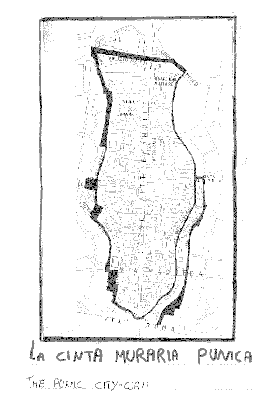
rivers, the Kemonia and the Papireto flowed. Remains of the town walls, which protected
the ancient centre of the town and which dated back to the Punic-Phoenician Age, are
visible.The town walls were made up of a double curtain-wall of squared stones. It was
filled with broken stones. The necropolis is one of the most important remains of our city
and dates back to the Phoenicians or the Punic Age. It occupied a large area comprised of
Piazza Indipendenza, Corso Calatafimi, Corso Pisani, Via Cappuccini and Via Danisinni. In our city many Phoenician traces have been found.The
name Panormus means “all harbour”. Before the eight century B.C., the
Phoenicians inhabited the promontories and the islets near the Sicilian coast and had
commercial relationswith the native population. When the Greek settlers arrive there, in
order to inhabit and cultivate the Sicilian lands, the Punic colony transferred to the
western port and formed the nuclei of three towns: Motya, Solunto and Palermo.The present
aspect of Palermo, is the result of the filling in of a wide and indented inlet where two
rivers, the Kemonia and the Papireto flowed. Remains of the town walls, which protected
the ancient centre of the town and which dated back to the Punic-Phoenician Age, are
visible.The town walls were made up of a double curtain-wall of squared stones. It was
filled with broken stones. The necropolis is one of the most important remains of our city
and dates back to the Phoenicians or the Punic Age. It occupied a large area comprised of
Piazza Indipendenza, Corso Calatafimi, Corso Pisani, Via Cappuccini and Via Danisinni.
© S.Lannino 2001 |


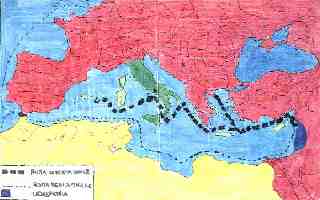
 ThePhoenicians
were people that originally came from the coastal zone which corresponds to the present
Lebanon. The name comes from a Greek word (Phoniks) which means “purple red”.
The main Phoenician cities were Byblos, Sidon and Tyre. They were city-states and had a
king as their head.
ThePhoenicians
were people that originally came from the coastal zone which corresponds to the present
Lebanon. The name comes from a Greek word (Phoniks) which means “purple red”.
The main Phoenician cities were Byblos, Sidon and Tyre. They were city-states and had a
king as their head.