 To switch between the two double-dipoles I use an Ameritron remote
switch (but when possibile I will try to get rid of it, because I
think it's better to have as few things as possible between tx
and antenna...).
To switch between the two double-dipoles I use an Ameritron remote
switch (but when possibile I will try to get rid of it, because I
think it's better to have as few things as possible between tx
and antenna...).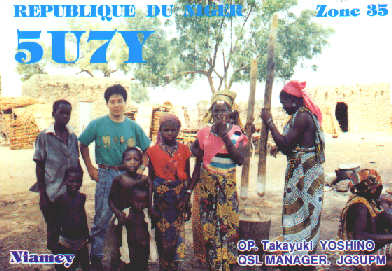 DX Century Club Award is given by
American Radio Relay League
to every radio amateur showing evidence of having contacted at least
100 different countries of the world.
DX Century Club Award is given by
American Radio Relay League
to every radio amateur showing evidence of having contacted at least
100 different countries of the world. I am particularly proud of my DXCC certificates, because I used only
the output power of my rig, a Kenwood TS-450S-AT, that is about 100 Watt.
I upgraded my initial DXCC score on March 2003, to 162 entities for mixed
and to 152 entities for phone mode.
I am particularly proud of my DXCC certificates, because I used only
the output power of my rig, a Kenwood TS-450S-AT, that is about 100 Watt.
I upgraded my initial DXCC score on March 2003, to 162 entities for mixed
and to 152 entities for phone mode.
 First antenna I used was a 80/40 m trapped dipole,
whose traps were done by printed circuit board pieces (to built capacitors) and
copper wire for the coils. Tuning were done modifying the total length
of the coils and a but also the length of wires, checking on the radio the
effects (this for fine tuning, by the way). I had amazing results on all
HF bands, I had main resonances on 80 and 40 and several others around.
Tuning a bit, with Kenwood internal tuner, you could work everything!
It's worth noting that at the time sunspot number was far higher than now.
First antenna I used was a 80/40 m trapped dipole,
whose traps were done by printed circuit board pieces (to built capacitors) and
copper wire for the coils. Tuning were done modifying the total length
of the coils and a but also the length of wires, checking on the radio the
effects (this for fine tuning, by the way). I had amazing results on all
HF bands, I had main resonances on 80 and 40 and several others around.
Tuning a bit, with Kenwood internal tuner, you could work everything!
It's worth noting that at the time sunspot number was far higher than now.
I also built other wire antennas, such as 160m loaded dipoles (with huge
coils!), G5RV with an homebrew balanced line ending in a 4:1 balun,
multi-dipole configurations and a 60m length wire loop, that performed
surprisingly well on LF listening (I will try something similar to work on
137 kHz, perhaps this winter).
At the moment I have on my roof two multi-dipole antennas, a 80m dipole
resonating on 3750 kHz coupled on the same 1:1 balun with a 40m dipole
resonating around 7030 kHz (the resonances apply to the two antennas
system). The other antenna is a trapped wire dipole for 10/15/20 m bands.
To switch between the two double-dipoles I use an Ameritron remote
switch (but when possibile I will try to get rid of it, because I
think it's better to have as few things as possible between tx
and antenna...).
Recently I have built an horrible two element yagi for 6 meters band,
for now attached to a third Ameritron plug (yes, I know, I should not
do this way) and without rotor (it steadily beams NW). The 28 MHz
output of the Kenwood is fed to an Italian made 6m transverter and
then to a 6m PA (a tube 27 MHz PA I bought for a few bucks at an hamfest
and modified to 50 MHz, simply changing input and output pi filters).
From the year 2000 I also use a second rig, an Icom 706 MKIIG, used for VHF/UHF
bands and also for HF operations when I am not home. It is very handy to carry this
small rig with me when traveling!
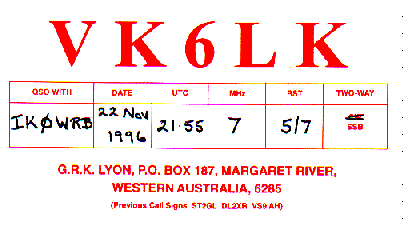
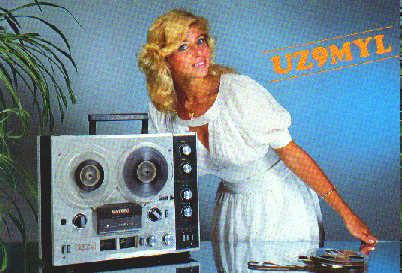
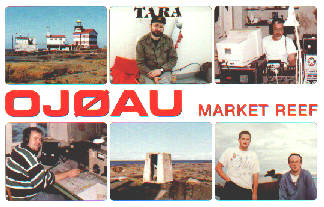 Well, after doing a lot of QSO the difficult part is how to get the
QSL
answered. ARI bureau works well, but you have sometimes to wait years
to receive a card back, so, as all DXers do, I began writing directly,
looking for managers and addresses on every possibile CD-ROM,
callbook, Internet sites, etc. And sending green stamps around, HI.
Well, after doing a lot of QSO the difficult part is how to get the
QSL
answered. ARI bureau works well, but you have sometimes to wait years
to receive a card back, so, as all DXers do, I began writing directly,
looking for managers and addresses on every possibile CD-ROM,
callbook, Internet sites, etc. And sending green stamps around, HI.